

major and minor scales piano pdf
Unlock piano mastery! Download our easy-to-follow PDF guide to major and minor scales. Perfect for beginners to advanced players. Start practicing today!
Major and minor scales form the bedrock of Western music, offering pianists a crucial foundation for understanding harmony and melody.
Exploring piano scale PDF resources unlocks a world of musical possibilities, enhancing technique and theoretical comprehension for all skill levels.
These scales, readily available in downloadable PDF formats, are essential for improvisation, composition, and overall musical fluency.
Mastering these scales provides a pathway to unlocking the expressive potential of the piano and deepening your musical journey.
What are Major and Minor Scales?
Major and minor scales are fundamental building blocks of tonal music, defining its harmonic and melodic character. A major scale typically evokes feelings of happiness and stability, characterized by a specific pattern of whole and half steps that create a bright, uplifting sound. Conversely, a minor scale often conveys emotions of sadness, melancholy, or drama, stemming from its distinct interval structure.
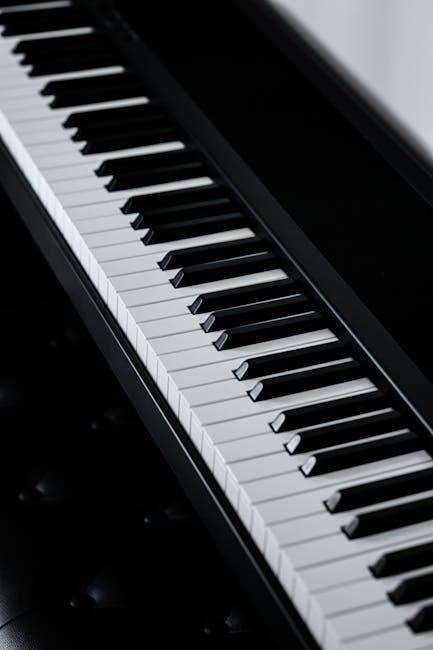
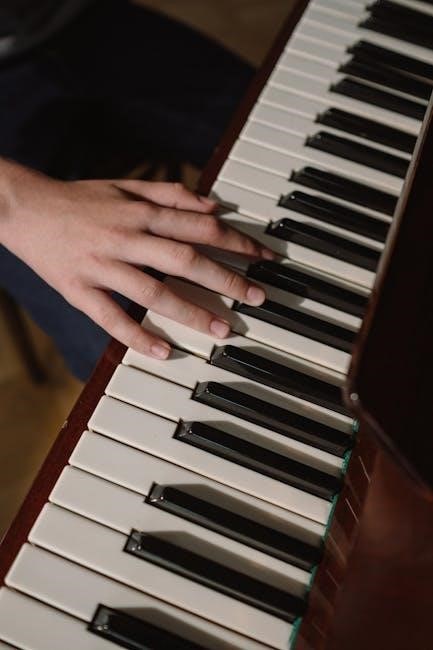
On the piano, understanding these scales involves recognizing the arrangement of white and black keys that correspond to these patterns. Many resources, including readily available PDF documents, visually represent these scales, aiding in memorization and practical application. These piano scale PDFs often include fingerings, making learning more efficient.
Essentially, a scale is a sequence of notes arranged in ascending or descending order. Major scales follow the formula W-W-H-W-W-W-H (Whole-Whole-Half-Whole-Whole-Whole-Half), while minor scales have variations (natural, harmonic, melodic) each with unique interval patterns. Accessing PDF guides simplifies grasping these nuances, providing a structured approach to scale learning.
Why Learn Major and Minor Scales?
Learning major and minor scales on the piano is paramount for any aspiring musician, extending far beyond simply playing notes. Scales are the foundation for understanding chords, harmonies, and key signatures, unlocking a deeper comprehension of music theory. Proficiency in scales dramatically improves technique, enhancing finger dexterity, coordination, and overall keyboard fluency.
Utilizing piano scale PDF resources provides a structured learning path, offering visual aids and fingerings to accelerate progress. These PDFs are invaluable for building muscle memory and internalizing the sound of each scale. Furthermore, scales are essential for improvisation, allowing musicians to confidently create melodies and solos within a given key.
Mastering scales also facilitates sight-reading, enabling quicker recognition of notes and patterns. Ultimately, a solid foundation in scales empowers pianists to analyze, compose, and perform music with greater understanding and artistry. Downloadable PDFs make this crucial learning process accessible and efficient.
Understanding Major Scales
Major scales, often cheerful and bright, are foundational to Western music, readily explored through accessible piano scale PDF resources.
These PDFs illuminate scale construction and fingering.
The Formula for a Major Scale
Understanding the formula is key to constructing any major scale on the piano, and numerous PDF resources visually demonstrate this concept.
The formula represents the intervals between the notes, expressed as whole steps (W) and half steps (H). The consistent pattern is: W-W-H-W-W-W-H.
Applying this to C Major (no sharps or flats) – starting on C, we move a whole step to D, another to E, a half step to F, and so on, following the pattern.
Piano scale PDFs often present this formula alongside the keyboard, clearly illustrating the placement of each note.
This formula isn’t just for C Major; it’s universal. To build a G Major scale, for example, you’d start on G and apply the same W-W-H-W-W-W-H pattern, adding sharps as needed to maintain the interval relationships.
These PDF guides frequently include exercises to practice applying the formula in different keys, solidifying your understanding and building muscle memory.
Mastering this formula unlocks the ability to build major scales in any key, a fundamental skill for any pianist.
Whole and Half Steps Explained
Whole and half steps are the building blocks of all scales, and piano scale PDFs often dedicate sections to clarifying these concepts visually.
A half step is the smallest interval in Western music – the distance between two adjacent keys on the piano, including black keys. For example, C to C# is a half step.
A whole step consists of two half steps. So, C to D is a whole step, as it encompasses C# and D.
Understanding this distinction is crucial because the major scale formula (W-W-H-W-W-W-H) relies entirely on precise whole and half step intervals.
Many PDF resources utilize keyboard diagrams to highlight whole and half steps, making the concept more intuitive.
They also demonstrate how sharps (#) and flats (♭) alter notes to create the necessary intervals. For instance, in G Major, F# creates the correct whole step between F and G.
Practicing identifying whole and half steps on the piano, guided by PDF exercises, is essential for scale mastery.
C Major Scale: A Starting Point
The C Major scale is universally recognized as the ideal starting point for learning scales on the piano, and is prominently featured in most piano scale PDFs;
Its simplicity stems from containing no sharps or flats – all white keys! This allows beginners to focus solely on finger technique and the whole/half step pattern (W-W-H-W-W-W-H).
PDF resources often present the C Major scale with suggested fingerings for both hands, optimizing smooth and efficient playing.
Typically, the right hand ascends with 1-2-3-1-2-3-4-5, while the left hand descends with 5-4-3-2-1-3-2-1.
Many PDFs include exercises for playing the scale ascending and descending, in different octaves, and with varying rhythms.
Mastering C Major builds a strong foundation for understanding scale construction and prepares you for scales with accidentals.

Consistent practice using piano scale PDFs will solidify your technique and musicality, paving the way for more complex scales.
G Major Scale: Introducing Sharps
The G Major scale marks a crucial step forward, introducing the concept of sharps and expanding your understanding beyond purely white-key scales, as detailed in many piano scale PDFs.
This scale contains one sharp – F♯ – which alters a note within the diatonic framework, requiring careful attention to key signatures.
PDF resources will visually highlight the F♯, often using altered notation, and provide fingerings adapted to accommodate the sharp.
Common right-hand fingering is 1-2-3-1-2-3-4-5, while the left hand often uses 5-4-3-2-1-3-2-1, adjusted for the F♯.
Practicing the G Major scale with piano scale PDFs emphasizes accurate execution of the sharp and maintaining consistent finger pressure.
Exercises often include playing the scale in different octaves and with varied rhythmic patterns to reinforce muscle memory.
Successfully navigating the G Major scale builds confidence in reading and playing scales with accidentals, preparing you for more complex keys.
F Major Scale: Introducing Flats
The F Major scale presents the first flat – B♭ – offering a contrasting experience to the sharps encountered in the G Major scale, and is thoroughly explained in many piano scale PDFs.
This introduces the concept of lowering a note by a half step, altering the familiar white-key pattern and demanding precise finger placement.
PDF resources will clearly indicate the B♭, often with a flat symbol preceding the note, and provide suggested fingerings for both hands.
A typical right-hand fingering is 1-2-3-4-1-2-3-4, while the left hand often utilizes 4-3-2-1-4-3-2-1, accommodating the B♭.
Utilizing piano scale PDFs during practice helps solidify the correct fingering and ensures accurate execution of the flat.
Exercises often involve playing the scale ascending and descending, in various octaves, and with different rhythmic variations;
Mastering the F Major scale builds proficiency in reading and playing scales with flats, expanding your harmonic vocabulary and technical skills.
Understanding Minor Scales
Minor scales evoke distinct emotions compared to major scales, and piano scale PDFs detail their construction.
These PDF resources explore natural, harmonic, and melodic minor variations, enriching your musical palette and technique.
Types of Minor Scales: Natural, Harmonic, Melodic
Minor scales aren’t monolithic; they present three primary variations, each with a unique character and application, readily explored through piano scale PDF resources.
The natural minor scale, the most basic form, maintains the same whole and half-step pattern as its relative major, offering a melancholic sound. PDFs often present this as a starting point for understanding minor tonalities.
The harmonic minor scale introduces a raised 7th degree, creating a stronger pull towards the tonic and a more dramatic, exotic flavor. Piano PDFs highlight this alteration and its impact on chord progressions.
Finally, the melodic minor scale differs in its ascending and descending forms. Ascending, it raises both the 6th and 7th degrees, smoothing the melodic line, while descending, it reverts to the natural minor form. PDFs demonstrate these variations, crucial for fluent melodic playing on the piano.
Understanding these distinctions, aided by comprehensive piano scale PDFs, is vital for musicians seeking to express a wider range of emotions and navigate complex musical landscapes.
Natural Minor Scale: The Relative Minor
The natural minor scale holds a special relationship with its relative major, offering a direct pathway to understanding key signatures and harmonic context, often detailed in piano scale PDFs.
To find the relative minor of any major scale, descend a minor third (three semitones) from the tonic of the major scale. For example, the relative minor of C major is A minor. PDF resources frequently illustrate this relationship visually.
Crucially, the relative minor shares the same key signature as its major counterpart. This means they utilize the same sharps or flats, simplifying transposition and harmonic analysis. Piano PDFs emphasize this shared characteristic.
The natural minor provides a darker, more introspective mood compared to its major relative. Exploring piano pieces in minor keys, alongside corresponding PDF scale charts, reveals this emotional contrast.
Mastering the concept of relative minors, aided by accessible piano scale PDFs, unlocks a deeper understanding of tonal harmony and expands your musical vocabulary.
Harmonic Minor Scale: Raising the 7th
The harmonic minor scale introduces a crucial alteration to the natural minor – raising the 7th degree by a half step. This modification, clearly demonstrated in piano scale PDFs, dramatically impacts the scale’s harmonic function.
Raising the 7th creates a leading tone, a note that strongly resolves upwards to the tonic, generating a more powerful sense of closure. Piano PDF resources often highlight this leading tone’s importance.
This alteration is vital for creating dominant chords in minor keys, essential for traditional harmonic progressions. PDF charts illustrate how the raised 7th enables a V-i cadence in minor.
However, the harmonic minor also introduces an augmented second interval between the 6th and 7th degrees, creating a unique melodic challenge. Piano players can find fingering suggestions in PDF guides.
Understanding the harmonic minor, with the aid of detailed piano scale PDFs, is fundamental for composing, improvising, and analyzing music in minor keys, unlocking richer harmonic possibilities.
Melodic Minor Scale: Ascending and Descending Variations
The melodic minor scale presents a fascinating departure from both natural and harmonic minor, featuring different forms for ascending and descending passages. Piano scale PDFs clearly illustrate these variations.
Ascending, the melodic minor raises both the 6th and 7th degrees, smoothing the augmented second interval found in the harmonic minor and creating a more lyrical sound. PDF resources often emphasize this melodic improvement.
However, descending, the melodic minor reverts to the form of the natural minor, lowering both the 6th and 7th degrees. This creates a different harmonic color and avoids the leading tone on the descent.

Piano players utilizing PDF guides will find fingering patterns tailored to both ascending and descending forms, optimizing technique and fluidity. Understanding this duality is crucial.
Mastering the melodic minor, with the help of comprehensive piano scale PDFs, unlocks a wider range of expressive possibilities and harmonic nuances in minor key compositions.

Scale Fingerings for Piano
Proper fingering is paramount for smooth piano scale execution, and PDF resources provide optimized patterns.
Consistent fingering builds muscle memory, enhancing speed and accuracy when practicing major and minor scales.
Piano scale PDFs offer clear diagrams, guiding players toward efficient hand positions and technical proficiency.
Importance of Proper Fingering
Proper fingering isn’t merely a suggestion; it’s absolutely fundamental to developing efficient and expressive piano technique when navigating major and minor scales. Utilizing correct fingerings, often detailed in piano scale PDF resources, allows for seamless transitions between notes, minimizing tension and maximizing speed.
Incorrect fingering can lead to awkward hand positions, hindering fluidity and potentially causing physical strain. These PDF guides often present multiple fingering options, catering to different hand sizes and preferences, but emphasize consistency within a given scale.
Consistent fingering builds crucial muscle memory, enabling you to play scales automatically, freeing your mind to focus on musicality and interpretation. Furthermore, understanding the logic behind fingering patterns – such as thumb tucks and finger crossings – facilitates learning new scales and pieces more quickly. Piano scale PDFs frequently highlight these patterns, making them easier to grasp. Ultimately, mastering fingering unlocks technical freedom and allows for a more nuanced and enjoyable playing experience.
C Major Scale Fingering
The C Major scale is the cornerstone for piano students, and its fingering is foundational. Typically, ascending, the right hand utilizes the fingering 1-2-3-1-2-3-4-5. This means starting with the thumb (1) on C, then index (2) on D, middle (3) on E, thumb (1) on F, and so on. Many piano scale PDFs visually represent this, aiding memorization.
Descending, the fingering reverses: 5-4-3-2-1-3-2-1. This requires a smooth thumb tuck under the hand when moving from the 3rd to the 2nd finger. PDF resources often emphasize this crucial transition. Left hand fingering mirrors the right, but reversed – 5-4-3-2-1-3-2-1 ascending, and 1-2-3-1-2-3-4-5 descending.
Consistent practice with this fingering, guided by piano scale PDFs, builds muscle memory and prepares you for more complex scales and pieces. Mastering the C Major fingering is a vital first step towards technical proficiency and musical fluency.
A Minor Scale Fingering (Natural, Harmonic, Melodic)
The A Minor scale presents variations in fingering depending on its form – Natural, Harmonic, or Melodic. Piano scale PDFs are invaluable for visualizing these differences. The Natural Minor (Aeolian) ascending right hand fingering is commonly 1-2-3-1-2-3-4-5, similar to C Major but starting on A.
The Harmonic Minor introduces a raised 7th (G#), altering the fingering slightly to accommodate the half-step. PDF resources highlight this adjustment. The Melodic Minor differs ascending and descending; ascending uses the raised 6th and 7th, with a fingering optimized for smoothness, while descending reverts to the Natural Minor form.
Left-hand fingering mirrors the right, reversed. Detailed piano scale PDFs often provide separate diagrams for each variation. Consistent practice with these fingerings, referencing PDF guides, builds dexterity and understanding of minor scale nuances.

Scale Practice Techniques
Consistent practice, utilizing piano scale PDFs, is key to mastery. Employ a metronome for rhythmic precision and explore scale variations.
Experiment with diverse rhythms and articulations to enhance musicality and solidify technique.
Slow and Consistent Practice
Slow practice is paramount when learning major and minor scales on the piano, especially when utilizing PDF resources. Resist the urge to rush; accuracy and evenness are far more valuable than speed initially.
Begin at a tempo where you can play each scale flawlessly, focusing on correct fingering and consistent tone production. Downloadable piano scale PDFs often include suggested fingerings – adhere to these initially to build proper muscle memory;
Consistency is equally crucial. Short, focused practice sessions – even 15-20 minutes daily – are more effective than infrequent, lengthy ones. Regular repetition reinforces neural pathways, solidifying your technique.
As you gain proficiency, gradually increase the tempo, but only if you can maintain accuracy. If mistakes creep in, immediately slow down. Utilize the PDF as a visual guide, checking your fingering and note accuracy frequently. Remember, building a solid foundation through slow, consistent practice will yield long-term results.
Using a Metronome
Integrating a metronome into your major and minor scales practice – alongside your piano scale PDF – is vital for developing rhythmic precision and consistency. A metronome provides an objective measure of tempo, exposing any inconsistencies in your playing.
Start with a slow tempo, ensuring each note aligns perfectly with the beat. Gradually increase the tempo in small increments, only progressing when you can play the scale accurately at the current speed. Many PDF resources suggest appropriate tempos for different skill levels.
Experiment with different subdivisions – playing scales with quarter notes, eighth notes, and triplets – to enhance your rhythmic versatility. The metronome will help you maintain evenness across these variations.
Don’t simply rely on the metronome; actively listen to the click and internalize the beat. This fosters a strong sense of timing, crucial for musicality. Consistent metronome practice, guided by your piano scale PDF, will dramatically improve your technique.
Scale Variations: Different Rhythms and Articulations

Beyond simply playing scales as written in your piano scale PDF, explore variations to enhance your technique and musical understanding. Experiment with different rhythmic patterns – dotted rhythms, syncopation, or triplets – to challenge your coordination and timing.
Vary the articulation: practice scales legato (smooth and connected), staccato (short and detached), and with accents on different beats. This develops finger dexterity and control. Many PDF resources offer suggested articulation exercises.
Try playing scales in different dynamic levels – piano, mezzo forte, forte – to improve your dynamic range and expressive capabilities. Combine rhythmic and articulatory variations for a more complex challenge.
These variations aren’t just technical exercises; they cultivate musicality and prepare you for interpreting a wider range of repertoire. Utilizing your piano scale PDF as a base, unlock creative possibilities!
Resources for Major and Minor Scales (PDFs)
Piano scale PDF resources abound online, offering comprehensive guides for all levels. Explore free options and consider investing in paid workbooks for structured learning.
These PDFs provide valuable practice material and theoretical insights.
Free Online PDF Resources
Numerous websites offer free downloadable PDF resources for major and minor scales on piano. These are excellent starting points for beginners and those seeking supplemental practice material. Websites like 8notes.com provide scale charts in PDF format, covering a wide range of keys and scale types, including natural, harmonic, and melodic minor.
Teoria.com offers interactive exercises and printable scale diagrams, though not strictly PDFs, they complement scale learning effectively. Many piano teachers also create and share free scale sheets on their personal websites or through online music education platforms. A simple Google search for “piano scales PDF” yields a plethora of results, including comprehensive scale guides and fingering charts.
However, it’s crucial to evaluate the source’s credibility and accuracy. Look for resources created by qualified music educators or reputable music publishers. While free resources are valuable, they may sometimes lack the detailed explanations or progressive exercises found in paid materials. Always cross-reference information and prioritize clear, accurate diagrams and fingering suggestions to avoid developing incorrect habits.
Paid PDF Workbooks and Courses
For a more structured and in-depth learning experience, consider investing in paid PDF workbooks and online courses focused on major and minor scales. Websites like Musicnotes.com and Sheet Music Plus offer a variety of scale workbooks, often categorized by skill level and musical style. These typically include detailed explanations, fingering exercises, and progressive practice routines.
Platforms like Udemy and Coursera host comprehensive piano courses that dedicate significant sections to scale mastery, often including downloadable PDF materials. These courses frequently feature video lessons, personalized feedback, and opportunities for interaction with instructors and fellow students.
Premium resources often provide a more systematic approach, addressing common challenges and offering targeted exercises to improve technique and musicality. While requiring a financial investment, these materials can accelerate learning and ensure a solid foundation in scale proficiency. Look for workbooks and courses created by experienced piano teachers or recognized music institutions to guarantee quality and accuracy.
Applying Scales to Chord Progressions
Understanding how scales relate to chords unlocks harmonic depth; piano PDF resources demonstrate this connection.
Scales provide melodic options over chord changes, enhancing improvisation and composition skills.
Utilizing PDF guides, pianists can seamlessly blend scales with chord progressions for richer musical expression.
Scales and Chord Relationships
Understanding the intimate connection between scales and chords is paramount for any pianist seeking to move beyond simply playing notes to truly making music.
Scales aren’t just exercises; they are the source material for chords, and chords, in turn, define the harmonic landscape over which scales can be creatively explored.
A major scale, for instance, naturally contains the notes that form the I, IV, and V chords within that key – the most fundamental building blocks of countless songs.
Similarly, a minor scale dictates the chords that will create a melancholic or dramatic feel.
Piano PDF resources often visually map these relationships, showing which scale degrees correspond to which chord tones.
These PDF guides demonstrate how to identify the chords built from a given scale and, conversely, which scales work best over specific chord progressions.
This knowledge empowers pianists to improvise confidently, create compelling arrangements, and understand the underlying structure of the music they play.
By studying these relationships through dedicated PDF materials, you unlock a deeper understanding of harmonic function and musical expression.
Ultimately, mastering this connection transforms a pianist from a note-reader into a musical storyteller.
Improvisation Using Scales
Improvisation, the art of spontaneous musical creation, becomes significantly more accessible and rewarding with a solid grasp of scales.
Knowing your major and minor scales allows you to confidently navigate chord changes and craft melodic lines that complement the underlying harmony.
Piano PDF resources dedicated to improvisation often present scales in the context of common chord progressions, demonstrating how to select notes that create pleasing sounds.
These PDF guides frequently include exercises designed to develop your ear and encourage experimentation.
Start by improvising over simple chord changes, focusing on using only the notes within the corresponding scale.
Gradually introduce variations, such as adding passing tones or incorporating rhythmic displacement.
Explore different scale positions and fingerings to expand your improvisational vocabulary.
Remember, improvisation isn’t about randomly hitting notes; it’s about making informed musical choices based on your understanding of scales and harmony.
Utilizing PDF materials as a springboard, you can unlock your creative potential and develop a unique improvisational voice.