

volleyball drills for beginners pdf
New to volleyball? Grab our free PDF with easy-to-follow volleyball drills for beginners! Improve your skills, learn the basics, and have fun on the court. Download now!
Beginner volleyball drills, often found in PDF guides, are crucial for skill development. Popular anime like Haikyuu!! inspire many to learn, offering exciting gameplay examples.
What is Volleyball and Why Learn?
Volleyball is a dynamic team sport played by two teams on a court divided by a net. The objective is to score points by grounding a ball on the opposing team’s side of the court under organized rules. It’s a fantastic way to improve physical fitness, coordination, and strategic thinking.
Learning volleyball offers numerous benefits, from enhanced cardiovascular health and muscle strength to improved reflexes and teamwork skills. The growing popularity, fueled by engaging content like the anime Haikyuu!! and series like Seiin Koukou Danshi Volley-bu, demonstrates its widespread appeal.
Many resources, including readily available volleyball drills for beginners in PDF format, make learning accessible. These guides often break down fundamental skills into manageable steps, perfect for newcomers eager to experience the excitement of the game.
Importance of Proper Training
Proper training is paramount in volleyball to prevent injuries and maximize performance. Starting with foundational volleyball drills for beginners, often available as PDF guides, establishes correct technique from the outset. Rushing into advanced skills without a solid base can lead to bad habits and potential physical strain.
Effective training isn’t just about repetition; it’s about focused practice with attention to form. Resources like online video tutorials and series such as Fate/stay night, while not directly instructional, showcase athletic dedication. Utilizing structured drills, found in beginner PDFs, ensures consistent improvement.
Consistent, well-planned practice builds muscle memory, enhances coordination, and fosters a deeper understanding of the game, mirroring the dedication seen in shows like Haikyuu!!.

Fundamental Skills to Practice
Volleyball drills for beginners, often in PDF format, focus on passing, setting, serving, hitting, and blocking – the core skills for success.
Passing Drills: The Foundation
Passing drills, frequently detailed in volleyball drills for beginners PDF guides, establish a solid foundation. Mastering the pass is paramount, as it initiates every offensive play. Begin with simple partner passing, focusing on platform formation – forearms together, angled upwards. Progress to drills involving movement, requiring players to quickly adjust to varying ball trajectories.
Wall passing is excellent for repetition and refining technique. Focus on consistent contact and directing the ball accurately to a target. More advanced drills incorporate a third player, simulating game-like passing scenarios. These PDF resources often emphasize the importance of a low center of gravity and controlled movements. Remember, a strong pass sets up the entire team for success, mirroring the dedication seen in series like Haikyuu!!.
Setting Drills: Precision and Control
Setting drills, commonly outlined in volleyball drills for beginners PDF materials, prioritize precision and control. The set is the crucial link between the pass and the hitter. Start with stationary setting, focusing on hand shape – forming a triangle with thumbs and index fingers. Progress to setting while moving, maintaining consistent hand positioning and accurate ball placement.
Partner setting drills enhance communication and timing. PDF guides often suggest drills where setters target specific spots, improving hitter approach coordination. Incorporate footwork drills to develop quick, efficient movements. Like the strategic plays in anime such as Haikyuu!!, a precise set can unlock powerful offensive opportunities. Mastering setting requires dedication and repetition, building a reliable offensive system.
Serving Drills: Accuracy and Power
Serving drills, detailed in many volleyball drills for beginners PDF resources, focus on both accuracy and power. Begin with stationary serves, emphasizing consistent ball contact and a smooth tossing motion. Target zones on the court to improve placement, mimicking strategic serves seen in competitive matches and even anime like Haikyuu!!.
Progress to serving from different distances, gradually increasing power while maintaining control. PDF guides often include drills for float serves and jump serves, catering to different skill levels. Practice serving under pressure by simulating game scenarios. Consistent practice builds confidence and reduces errors. A powerful, accurate serve can immediately put the opposing team on the defensive, creating scoring opportunities.
Hitting/Spiking Drills: Developing Offensive Skills
Hitting/Spiking drills, commonly found in volleyball drills for beginners PDF guides, are essential for developing offensive prowess. Start with approach footwork drills, focusing on a consistent and explosive jump. Practice arm swings without a ball to refine technique, mirroring the dynamic movements seen in series like Haikyuu!!.
Then, incorporate a ball, beginning with toss-and-hit drills. PDF resources often detail drills for hitting from different positions on the net. Gradually increase hitting velocity and focus on targeting specific areas of the court. Partner drills help develop timing and coordination with the setter. Mastering the spike requires consistent practice and attention to detail, transforming potential into powerful offensive plays.
Blocking Drills: Defensive Wall
Blocking drills, detailed in many volleyball drills for beginners PDF resources, build a strong defensive presence at the net. Begin with footwork drills, emphasizing quick lateral movements and proper positioning – mirroring the intensity of competitive play often showcased in anime like Haikyuu!!.
Practice jumping with arms extended, forming a solid block. Partner drills involve a hitter approaching and spiking, while the blocker focuses on timing and penetration over the net. PDF guides often include drills for reading the hitter’s approach and anticipating the spike’s trajectory. Consistent practice improves reaction time and the ability to create a formidable “wall,” effectively shutting down the opponent’s offense.
Drills Focusing on Individual Skills
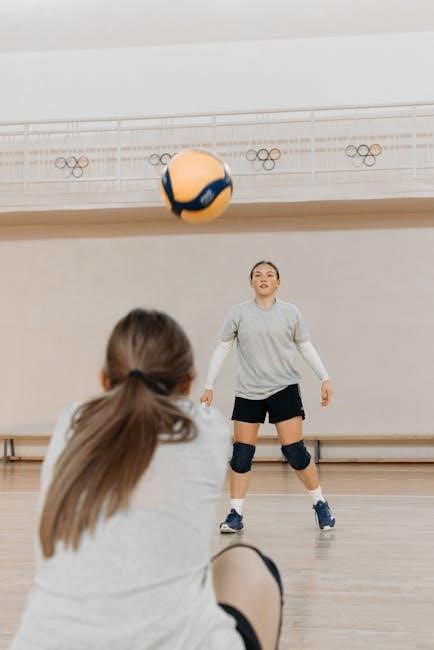
Volleyball drills for beginners PDF resources emphasize solo practice. Mastering fundamental skills—passing, setting, serving—requires dedicated repetition and focused individual effort.
Wall Passing Drill: Repetition and Form
The wall passing drill, frequently detailed in volleyball drills for beginners PDF guides, is a cornerstone for developing foundational passing technique. This drill focuses on repetitive contact, allowing players to refine their platform, body positioning, and consistent ball control without the pressure of a partner.
Begin by standing a comfortable distance from a wall – approximately 5-10 feet. Players should focus on creating a stable base, maintaining a slight bend in the knees, and presenting a flat, angled platform with their forearms. The goal is to pass the ball against the wall and control the rebound, repeating the motion consistently.
Variations include focusing on different passing angles, increasing the distance from the wall, or incorporating movement before each pass. Consistent practice with this drill builds muscle memory and improves reaction time, essential skills highlighted in introductory volleyball resources.
Pepper Drill: All-Around Skill Development
The Pepper drill, a staple in volleyball drills for beginners PDF resources, is a dynamic exercise designed to enhance multiple skills simultaneously. It’s a fast-paced drill involving two players closely positioned, focusing on passing, setting, and hitting in rapid succession.
One player begins by gently passing the ball to their partner, who then sets it back. The initial player attempts a controlled hit, aiming for a soft touch to allow the rally to continue. The drill emphasizes quick reactions, accurate ball control, and consistent form.
Players rotate roles, ensuring they practice all three skills. Variations include limiting touches, focusing on specific hitting targets, or adding movement. This drill, often showcased in introductory guides, builds all-around volleyball proficiency and hand-eye coordination.
Serving Line Drill: Consistency Practice
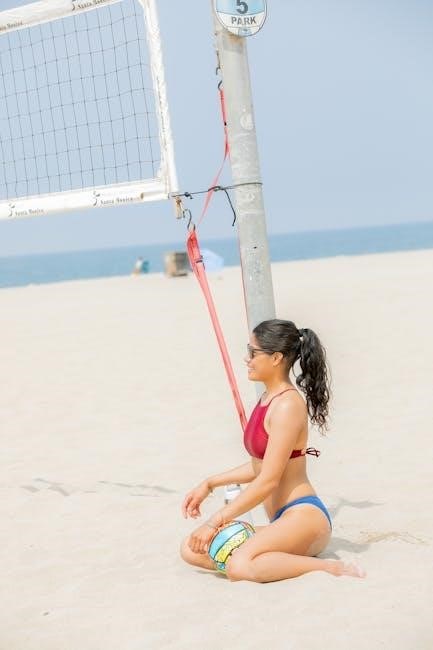
Serving line drills, frequently detailed in volleyball drills for beginners PDF guides, are fundamental for developing a reliable serve. This drill focuses on repetition and refining technique, aiming for consistent accuracy and controlled power. Players line up behind the service line and practice serving to designated targets on the opposite court.
Beginners often start with underhand serves, gradually progressing to overhand techniques as their form improves. The drill emphasizes a consistent pre-serve routine, proper toss, and follow-through. Coaches often provide feedback on stance, arm swing, and contact point.

Variations include serving to specific zones, tracking serve statistics, or incorporating a scoring system. Consistent practice, as highlighted in many beginner resources, builds confidence and reduces errors during gameplay.
Approach and Swing Drill: Hitting Mechanics
Approach and swing drills, commonly found within volleyball drills for beginners PDF resources, are essential for developing proper hitting technique. This drill breaks down the hitting motion into its core components: the approach, jump, arm swing, and follow-through. Players begin by practicing the footwork pattern – a four-step approach – focusing on timing and explosiveness.
Next, they integrate the arm swing, emphasizing a high elbow and full range of motion. Coaches often use visual cues and provide feedback on body positioning and hand contact. The drill progresses from stationary swings to full approaches, culminating in hitting over the net.
Consistent repetition, as detailed in beginner guides, builds muscle memory and improves hitting accuracy and power. Anime like Haikyuu!! visually demonstrate these mechanics.
Blocking Footwork Drill: Positioning and Timing
Blocking footwork drills, frequently detailed in volleyball drills for beginners PDF guides, concentrate on developing quick lateral movement and precise positioning at the net. This drill emphasizes the shuffle step – a quick, efficient movement used to track the hitter’s approach. Players practice shuffling along the net, maintaining a low center of gravity and active hands.
Timing is crucial; players learn to jump simultaneously with the hitter, forming a solid block. Coaches often use visual cues, like a verbal command or hand signal, to initiate the jump. Drills progress from individual footwork to partner blocking, simulating game-like scenarios.
Resources often highlight the importance of reading the hitter’s approach and anticipating their attack. Observing skilled players, even in anime like Haikyuu!!, can aid understanding.
Partner Drills for Skill Enhancement
Partner volleyball drills, often detailed in PDF resources, build communication and teamwork. Anime like Haikyuu!! showcase effective partner play and chemistry.
Two-Person Passing Drill: Communication and Accuracy
This drill, frequently outlined in beginner volleyball PDF guides, focuses on developing fundamental passing skills and, crucially, communication. Players face each other approximately five to ten feet apart. One player gently tosses the ball to their partner, who aims for a controlled platform pass back.
Emphasis should be placed on calling the ball (“Mine!”) and providing clear, concise feedback to each other. Beginners often struggle with consistent platform formation; this drill provides repetition. Progress by increasing distance, adding movement (shuffling steps), and varying toss heights.
Watching anime like Haikyuu!! can visually demonstrate the quick communication and precise passing necessary for successful rallies. The goal isn’t power, but accuracy and control, building a solid foundation for more advanced techniques.
Setter-Hitter Combination Drill: Building Chemistry
Many beginner volleyball PDF resources detail this essential drill, designed to foster a strong connection between the setter and hitter. The drill begins with the setter facing the hitter a short distance away. The setter practices setting various locations (front, back, middle), while the hitter focuses on approaching and timing their jump for the set.

Communication is paramount – hitters should call for the set location, and setters should provide feedback on timing. Initially, focus on consistent sets and controlled approaches. As skills improve, increase the speed and complexity of the sets.
Observing dynamic plays in shows like Haikyuu!! highlights the importance of this synergy. This drill builds trust and anticipation, crucial for effective offensive plays.
Serve Receive and Set Drill: Transition Practice
Beginner volleyball PDF guides frequently emphasize this drill for mastering the crucial transition from defense to offense. One player serves, while others practice receiving the serve and immediately transitioning into a setting position. The setter then delivers a set to a designated hitter for an approach and simulated attack.
This drill focuses on quick reactions, accurate passing, and seamless transitions. Players should prioritize platform control during the receive and efficient footwork to reach the setting position. Communication is key – calling “pass!” and “set!” helps coordinate the play.
Watching competitive volleyball, even animated series, demonstrates the speed of these transitions. Consistent practice builds muscle memory and improves team coordination.
Team Drills for Game Simulation
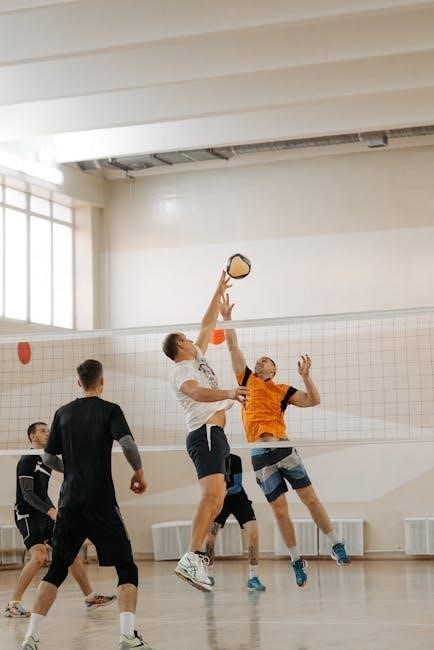
PDF resources highlight team drills mimicking game scenarios, like modified scrimmages and rotation practice, building cohesion and applying learned skills effectively.
Scrimmage with Modified Rules: Controlled Practice
Scrimmages, detailed in many volleyball drills PDF guides, are invaluable for beginners, but require careful modification. Initially, limit rotations or enforce specific hitting requirements – for example, only allowing outside hitters to attack. This controlled environment minimizes errors and maximizes repetition of fundamental skills.
Focus on specific areas like serve receive or transition from defense to offense. Consider implementing a “three-touch” rule to encourage teamwork and deliberate playmaking. These adjustments allow coaches to observe player performance in a game-like setting without the overwhelming pressure of full competition.
The goal isn’t winning, but rather consistent application of learned techniques. Observing anime like Haikyuu!! can inspire strategic thinking, but remember to prioritize foundational skill development during these modified scrimmages. Regularly debrief after each scrimmage, focusing on areas for improvement.
Rotation Drills: Understanding Positioning
Rotation drills, often outlined in volleyball drills PDF resources, are fundamental for beginners grasping court positioning. Start with simplified rotations, focusing on moving one position clockwise after each point. Emphasize the importance of knowing where to be before the ball is served, mirroring the strategic play seen in series like Haikyuu!!.
Introduce the concept of covering zones and responsibilities within each rotation. Use visual aids or diagrams to illustrate proper positioning. Gradually increase the complexity, adding defensive and offensive responsibilities.
Drills should emphasize quick transitions and communication. Players must learn to anticipate their next position and communicate effectively with teammates. Consistent practice builds muscle memory and reduces confusion during actual game play, fostering a cohesive team dynamic.
Transition Drills: Offense to Defense
Transition drills, frequently detailed in volleyball drills PDF guides, are vital for developing quick reactions. These drills simulate the rapid shift from attacking to blocking or defending, mirroring the fast-paced action of shows like Haikyuu!!. Begin with simple scenarios: a simulated attack followed immediately by a defensive setup.
Focus on players’ ability to quickly read the opponent’s attack and transition into a blocking position. Incorporate drills where players must sprint from an offensive position to cover a specific area on the court.
Communication is key during transitions; players must call out their intentions and coordinate movements. Consistent practice improves reaction time and court awareness, enabling a seamless shift between offense and defense.
Resources for Further Learning (PDFs & Online)
Volleyball drills PDF guides and online tutorials, like those inspired by Haikyuu!!, offer structured training plans for beginners to enhance their skills.
Recommended Volleyball Drill PDFs
Numerous volleyball drill PDFs cater specifically to beginners, providing a structured path for skill acquisition. These resources often categorize drills by fundamental skill – passing, setting, serving, hitting, and blocking – allowing focused practice. Many PDFs detail progression drills, starting with simple repetitions and gradually increasing complexity.
Look for PDFs from reputable volleyball organizations or coaching clinics. Some excellent sources include those offered by USA Volleyball and various collegiate programs. These documents frequently include diagrams illustrating proper technique and common errors to avoid.
Consider searching for PDFs tailored to specific age groups or skill levels. A beginner’s PDF will differ significantly from one designed for intermediate or advanced players. Remember to prioritize drills that emphasize proper form and technique over sheer power or speed, especially when starting out. Resources inspired by popular series like Haikyuu!! can also offer engaging drill ideas.
Online Video Tutorials and Resources

Complementing volleyball drill PDFs, online video tutorials offer a dynamic learning experience. Platforms like YouTube host countless channels dedicated to volleyball instruction, showcasing drills in action. Visual learners benefit greatly from observing proper technique and identifying common mistakes. Search for beginner-specific playlists or channels focusing on fundamental skills.
Websites like USA Volleyball’s and TeamSnap’s provide articles and videos covering various aspects of the game, including drills. Many collegiate volleyball programs also share training content online. Consider resources inspired by popular anime like Haikyuu!! for motivational examples.
When selecting videos, prioritize those from certified coaches or experienced players. Look for clear explanations, slow-motion demonstrations, and drills that align with the PDF resources you’re utilizing. Remember to practice safely and focus on proper form.
Safety Considerations for Beginner Drills
Volleyball drill PDFs should emphasize warm-ups and proper form to prevent injuries. Prioritize suitable footwear and attire for optimal performance and safety.
Warm-up and Cool-down Routines
Prior to any volleyball drills – as detailed in many beginner PDF guides – a dynamic warm-up is essential. This should include light cardio like jogging, followed by arm circles, leg swings, and torso twists. Focus on movements mimicking volleyball actions, preparing muscles for exertion.
Specifically, shoulder rotations and wrist flexes are vital, given the repetitive overhead motions. A proper warm-up minimizes injury risk and maximizes performance. Conversely, a cool-down is equally important.
Static stretching – holding each stretch for 20-30 seconds – helps improve flexibility and reduce muscle soreness. Include stretches for calves, hamstrings, quads, shoulders, and triceps. Consistent warm-up and cool-down routines, often outlined in downloadable drill resources, are non-negotiable for beginner players.
Proper Footwear and Attire
Beginner volleyball drills, as outlined in many PDF resources, demand appropriate attire for safety and performance. Volleyball-specific shoes are paramount; they provide crucial lateral support and cushioning for jumping and quick movements. Avoid running shoes, as they lack the necessary stability.
Clothing should be comfortable and allow a full range of motion. Moisture-wicking fabrics are ideal, keeping players dry and preventing chafing. Shorts or spandex are common choices, while fitted shirts prevent interference during arm swings.
Knee pads are highly recommended, especially during drills involving diving or floor contact. Ankle braces can offer additional support, particularly for players prone to ankle injuries. Following these guidelines, often detailed in beginner drill guides, ensures a safer and more effective training experience.